
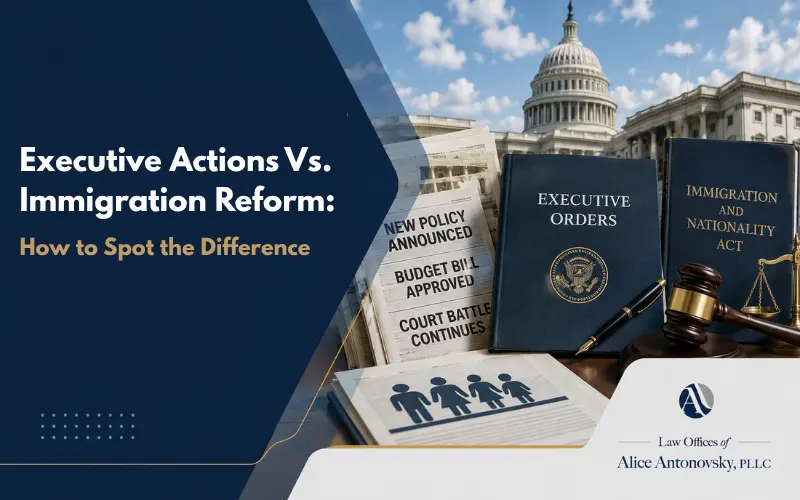
Anyone who’s been watching the news lately would believe the entire immigration system is being rewritten overnight. It is completely understandable. Between political announcements, massive budget votes, and high-stakes courtroom battles, it feels like the rules are shifting constantly.
However, there is a fundamental misunderstanding driving most of these headlines: the public is constantly confusing temporary enforcement moves with actual systemic reform.
Behind the daily noise, the baseline laws that govern U.S. immigration remain virtually identical to what they were decades ago. Here is why what you are seeing in the news is not immigration reform, why that distinction matters, and how to spot the difference.
The Reality Check: Three Levers of Power
To understand why the public conversation gets so confused, it helps to look at the three levers of federal power. Only one of them creates real reform.
- Administrative Actions & Executive Orders
These are directives issued directly by the White House or federal agencies like the Department of Homeland Security to dictate how existing laws are enforced day to day. While they often make breaking news, they are not structural reform. What one president signs with the stroke of a pen, a court can quickly pause, or a future president can instantly undo. They change short-term enforcement tactics, not the underlying law.
- Fiscal Allocation & Enforcement Spending
This occurs when Congress uses budgetary tools to direct billions of dollars toward border technology, detention facilities, or enforcement personnel. Funding certainly scales up operational capacity, but throwing money at enforcement is not reform. It does not alter who qualifies for a visa, establish new legal pathways, or update outdated statutory visa limits.
- True Legislative Reform
Real reform requires Congress to pass comprehensive, bipartisan legislation that updates the foundational law itself, specifically the Immigration and Nationality Act. This is the only lever that actually modernizes the system. It creates permanent pathways to legal status, adjusts employment visa caps to match current needs, and establishes long-term stability for both individuals and businesses.
Right now, we are witnessing a massive wave of executive changes and budget spending and mistaking it for a rewritten system.
Why Current Headlines Aren’t Showing You Real Reform
Instead of actual legislative changes, what we are seeing in the news right now boils down to three temporary pressure points:
More Spending, Same Bottlenecks
Congress keeps throwing historic billions into border technology, physical infrastructure, and personnel. But here is the problem: when you flood the front end of a system with resources without funding the courts that process the cases, you do not solve the issue. You just create massive backlogs. It is like adding lanes to a highway that feeds directly into a single toll booth.
The Executive Order Loophole
Presidents often use executive actions to push political boundaries, but these mandates frequently trigger instant court battles. We saw this when executive orders attempted to restrict constitutional guarantees like birthright citizenship, only to be struck down in court. This constant back-and-forth between executive orders and court blocks creates regulatory whiplash, not lasting policy.
Administrative Red Tape
Behind the scenes, agencies are quietly changing how immigration works by hiking up fees. Between mandatory visa integrity fees and high bond requirements, the process is becoming significantly more expensive for both families and employers. Increasing the cost of entry changes who can afford to apply, but it does not fix the broken system itself.
What Real Reform Actually Looks Like
Real reform means Congress actually changes the underlying law. Here is what genuine statutory solutions look like in practice:
Bipartisan Legislation (Like the Dignity Act)
This combines border security with real structural fixes, offering conditional legal status for long-term residents who pass background checks, permanent protections for Dreamers, and updated visa caps that reflect current workforce needs.
State-Sponsored Worker Programs
These proposals allow individual states to directly sponsor foreign workers under federal law, directly solving specific regional labor shortages in industries like agriculture, construction, and healthcare.
Court and Systems Modernization
Real reform restores discretion to immigration judges, dramatically expands court capacity to resolve backlogs, and establishes binding standards for detention facilities.
Final Thoughts
The next time you see a breaking headline about major immigration shifts, pause and ask yourself one simple question:
Did Congress actually change the law, or did an agency just change how it enforces it?
Until lawmakers pass comprehensive legislation that updates legal pathways, balances labor needs, and fixes the courts, we are not witnessing immigration reform. We are simply watching temporary executive adjustments to a system that remains fundamentally unchanged.
Need clarity on how these administrative shifts impact your business, visa status, or long-term strategy? Don’t navigate the legal noise alone. Reach out to the Law Offices of Alice Antonovsky team today to schedule a strategic consultation.